There are conversations that aren’t easy to prepare for.
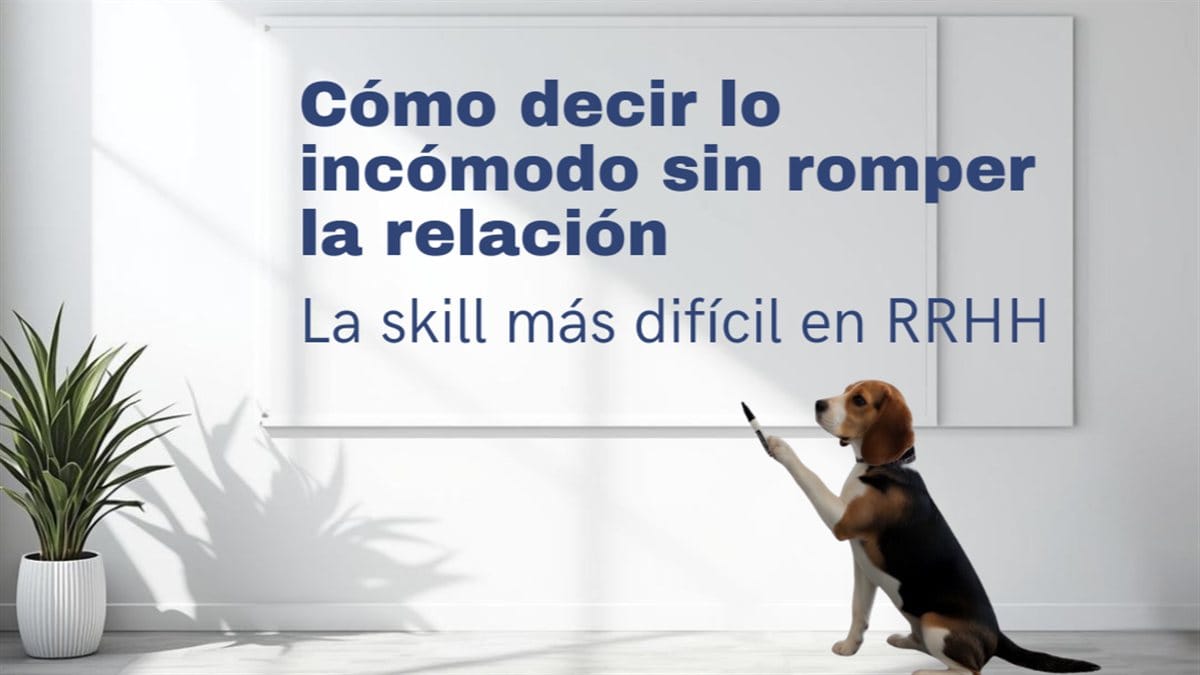
I’m Nara, the mascot of HR professionals, and today I want to talk to you about three skills I find essential when you have to point out things to improve without the other person taking it as an attack.
I’m talking about the skill of saying the uncomfortable without breaking the relationship.
In HR there are moments when you have to point out something that isn’t working. It can range from an attitude to a situation that’s starting to affect the team.
The conversation is often prepared with some tension because you know the message matters. But you also know that the way it’s received can change everything.
Some people hear feedback and can consider it calmly. And others, the moment they feel something about them is being questioned, shut down.
This happens because the human brain interprets very quickly whether a conversation is experienced as an opportunity to improve or as a threat to identity.
That’s why, when you give feedback, what you say isn’t the only thing that matters.
What matters is how you help the other person hear it without having to defend themselves from the very first minute.
Here are three skills that will help you in this kind of conversation.
Skill 1
Separating the message from the person’s identity
This is probably one of the most important skills when you have to give feedback.
Many conversations get complicated when the person feels you’re not talking about something that happened, but about who they are.
It’s not the same to say:
“You’re disorganized.”
As to say:
“On this project we’ve seen that some deadlines have slipped, and it’s worth reviewing how we’re organizing the follow-up.”
The first sentence touches identity.
The second points to a specific situation.
When feedback touches identity, the person tends to protect themselves. They may justify, shut down or become defensive.
When feedback focuses on an observable behavior, on the other hand, it’s easier for the other person to look at it with some distance.
This changes the conversation enormously.
Because the goal of feedback shouldn’t be for someone to feel singled out, but for them to understand what happened and what can be adjusted.
For example, it’s not the same to say:
“You’re not collaborating with the team.”
As to say:
“In the last few meetings it’s been hard to make progress because some responses came in late. I think it would be useful to review how we can improve that coordination.”
In the second case, you’re not putting a label on the person, you’re putting attention on a situation.
Feedback becomes easier to receive when the person doesn’t feel they have to defend who they are.
Skill 2
Regulating the tone before the words
When a person receives feedback, they don’t only hear the content.
Unconsciously, they also perceive the tone, the pace, the physical tension and the intention it’s being spoken from.
The brain interprets all of that very quickly.
That’s why, very often, rejection doesn’t start with the exact phrase used.
It starts with how the other person feels it’s being said to them.
In HR this is especially important because there are conversations where the content already carries enough weight.
If it’s also delivered from tension, haste or judgment, the conversation can shut down before it begins.
Regulating the tone before the words means entering the conversation at a pace that allows listening.
It’s not about softening the message so much that it loses clarity, but about taking care of the climate the message is going to arrive in.
For example, it’s not the same to start by saying:
“We need to talk about something that isn’t working.”
As to say:
“I wanted to go over something specific with you so I understand it well and we can see how to adjust it.”
The idea may be similar.
But the climate each sentence opens is very different.
In a delicate conversation, tone can become a door or a barrier.
And when tone opens, the person usually has more capacity to hear what comes next.
Skill 3
Closing the conversation without leaving it emotionally open
There are conversations that seem to end, but internally keep going around for hours.
Sometimes it happens to the people who receive feedback and often it also happens to the one who gives it.
This happens because the human brain tries to close the situations it perceives as emotionally relevant.
When a conversation ends ambiguously, the mind tends to keep looking for a way out.
That’s why, in feedback, closure also matters a great deal.
It’s not enough to say what needed to be said.
The conversation needs to make clear what has been understood, what the next step is and how the relationship will keep being cared for from there on.
For example, ending with a “well, we’ll keep an eye on it” can leave too much space open.
Instead, closing with something like:
“Thank you for talking it through with me. What matters now is that we’re clear on the next step and review it calmly in a few days.”
Helps give the conversation a clearer way out.
That closure doesn’t remove the discomfort, but it reduces the feeling of staying inside the conversation after having ended it.
And for an HR professional, that also matters. Because holding difficult conversations doesn’t mean carrying them around all day.
It means being able to say what’s needed, care for the bond and come out of the conversation with a bit more clarity.
Humántica®
The body influences the tone.
The mind helps to order the message.
Emotion allows you to care for the bond without losing clarity.
When these three parts aren’t aligned, a conversation can become much harder than it seemed at first.
You can be clear about what you want to say, but if you go in with tension, that tension communicates too.
You can have a well-prepared message, but if you don’t take care of how the other person receives it, the content can get lost.
And you can have said what was needed, but if you don’t close well, the conversation can stay open inside for much longer.
As you’ll see, giving feedback isn’t just learning a communication technique.
Working with body, mind and emotion is the fundamental system that will activate your best version in HR and also the talent of your teams — that’s Humántica.
I’ll still be around here, watching closely how you work… and learning too from everything you hold up each day.
And who knows, maybe at some point we’ll cross paths at the office — I almost always go with Berta to her meetings with HR.
— Nara
P.S.: How are you doing with the whole giving-feedback thing?